How to Shorten a Screw for a Lightsaber Hilt
Yes, you can cut a screw shorter. Thread a nut on past the cut line, clamp the screw, saw it with a hacksaw or rotary tool, file a slight bevel on the end, then back the nut off to clean the thread. Wear eye protection. If the screw is hardened or the thread is unknown, buy the right length.
Short answer
Yes, you can cut a screw shorter. Thread a nut on past the cut line, clamp the screw, saw it with a hacksaw or rotary tool, file a slight bevel on the end, then back the nut off to clean the thread. Wear eye protection. If the screw is hardened or the thread is unknown, buy the right length.
On this page11 sections
You can cut a screw shorter, and the nut trick keeps the thread usable. Thread a nut on past the cut line, clamp the screw, saw it with a hacksaw or a rotary tool, file a slight bevel on the end, then unscrew the nut so it cleans the thread as it comes off [3][4]. Wear eye protection. If the screw is hardened or you do not know the thread, buying the right length is faster.
Last checked: 2026-11-07.
Can you cut a screw shorter
Yes, for a normal soft steel or brass machine screw. A long thread on a model engineers’ forum lists several methods, and the most common is a nut on the thread, a hacksaw cut and a file [4].
To make a screw shorter and still usable, the risk to manage is the thread. A saw leaves a burr, and a burr stops the screw from entering the hole. The nut trick and a small bevel fix that [3].
Measure twice before you cut a screw you cannot replace. A screw that is too short cannot be lengthened.
What you need
| Item | Why |
|---|---|
| Safety glasses | Metal pieces and sparks [3][8] |
| Two nuts of the same thread | One protects the thread, one locks against it |
| Vise or locking pliers | A screw that spins gives a crooked cut [3] |
| Fine hacksaw or rotary tool | See the tool table below |
| Marker and ruler or caliper | Cut line |
| Small flat or needle file | Remove the burr and add a bevel [3] |
| Matching die or thread file | Only if the thread is damaged [3] |
Cut a screw shorter step by step
- Measure the length you need (see the next section) and mark the cut line on the shank with a marker [3].
- Thread a nut on past the cut line, so it sits on the part you will keep. A second nut locked against the first gives a firmer hold on bigger bolts [3][4].
- Clamp the screw in a vise or locking pliers with the cut line just outside the jaws [3].
- Cut a little long, about one thread beyond the line. You can always remove more later, and filing is easier than a second saw cut.
- Use long, steady hacksaw strokes, or short bursts with a rotary tool so the screw does not heat up [3].
- File the end flat and add a slight bevel [3]. The bevel helps the thread start in the hole.
- Unscrew the nut over the cut end. As it passes the damaged threads it reshapes and cleans them [3][4].
- Test the screw in the hole by hand. It should start without force. If it binds, stop and clean the thread again.
Hacksaw, rotary tool or bolt cutters
| Tool | Good for | Watch out for |
|---|---|---|
| Hacksaw, bi-metal | Slow, controlled cuts in steel and brass | Blade must suit the size, see below [3][5] |
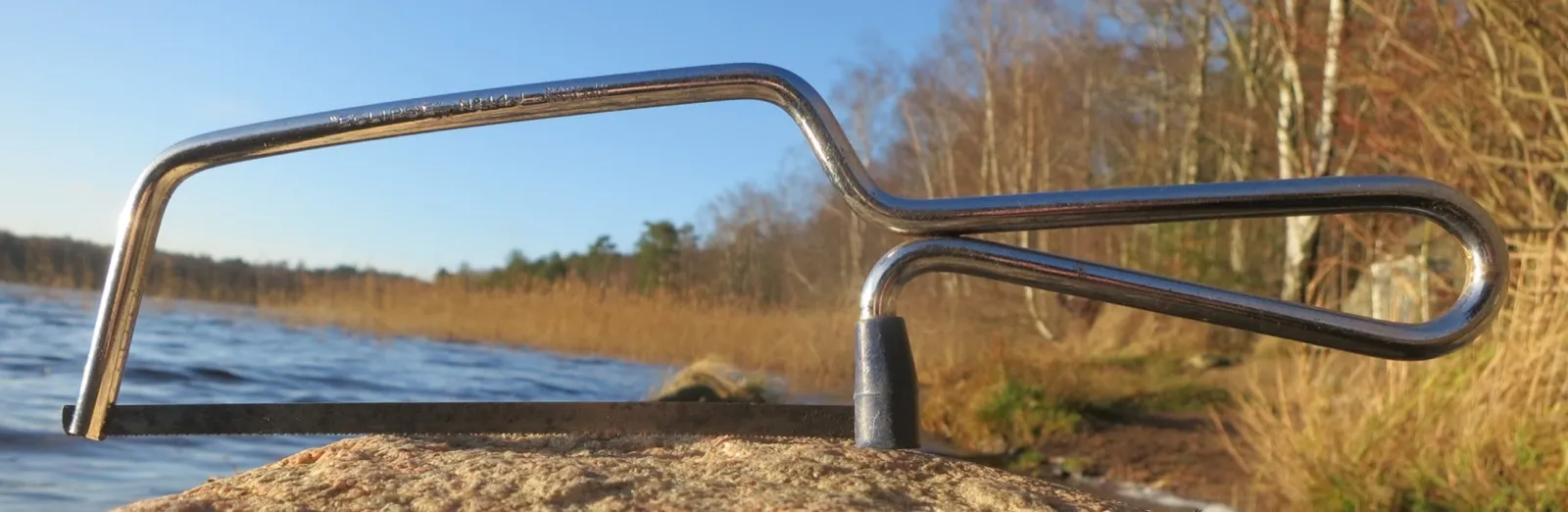
| Junior hacksaw | Small screws and tight spots | Short strokes, more patience [4] |
| Rotary tool, cut-off disc | Quick cuts, hard steel | Heat, sparks, thin discs that snap [3] |
| Bolt cutters | Large bolts, chain, rebar [9] | Oversize for a #8 screw (our inference), still needs filing |
For a hacksaw, one industrial guide gives the rule that at least three teeth should touch the work at all times. It lists 24 teeth per inch for 2 to 6 mm thick material and 32 teeth per inch for under 2 mm [5]. A #8 shank is about 4 mm across, so 24 or 32 teeth per inch is a sensible pick. A bi-metal blade tolerates a little twist better than an all-hard blade, which can snap [5].
Brass is a copper and zinc alloy and is soft, so it cuts easily and also burrs easily [10]. File brass lightly, and do not clamp it so hard that the thread crushes.
Measure the length you need
Measure the screw from under the head to the tip. Some thumb screw listings state the length in a separate field from the thread length, so check what a shop means by “length” [6]. A thumb screw with a shoulder under the head makes the two numbers differ.
For a blade retention screw, tighten it gently against the blade plug or blade and check that the tip does not bottom out in the bore. One maker warns that too much pressure can crack the blade or strip the retention screw [7]. A screw that is too long is a common reason a blade will not seat, because the tip sits in the way [7].
Fix a damaged thread
If the end is mushroomed or the nut will not run over the cut, work on the thread, not the screw head.
- Run the nut on and off a few times, with light oil if it binds.
- A thread restoring file or a die of the matching size can reshape worse damage [3].
- Leave the die for last, since a wrong die cuts a new thread rather than repairing the old one. Match the pitch first with a pitch gauge.
Thumb screws for blade retention
A blade retention thumb screw is the same retention screw with a head you turn by hand, with no tool needed [11]. People look for 8-32 brass thumb screws for this because the thread is common in hardware listings.
One shop lists a #8-32 brass thumb screw at a nominal length of 1 inch, with a right-hand full thread [6]. That shop lists a full thread, which means you can cut it and still have thread left. The same part has a knurled head, so the knurling makes it easy to grip.
Brass is gentler on a hilt than steel, and it is softer, so it wears first and protects the hole (our reading, not a maker claim). Do not assume your hilt uses 8-32. Hilt makers vary, and old forum threads that quote 8-32 are not a maker standard [7].
Thread sizes 8-32 and metric
| Name | Standard | Major diameter | Pitch |
|---|---|---|---|
| 8-32 UNC | Unified Thread Standard, coarse | 0.164 in (4.17 mm) | 32 threads per inch (0.794 mm) [1] |
| 8-36 UNF | Unified Thread Standard, fine | 0.164 in | 36 threads per inch [1] |
| M4 coarse | ISO metric | 4 mm | 0.7 mm [2] |
| M5 coarse | ISO metric | 5 mm | 0.8 mm [2] |
Inch and metric threads share a 60 degree profile, but their diameters and pitches differ [1]. An M4 screw is close to an 8-32 in diameter and has a different pitch, so do not force one into the other (our inference from the figures).
A search for an “8mm thumb screw” usually means a #8 screw. An M8 screw is 8 mm across, about twice the width of a #8 at 4.17 mm [1][2]. A thumb nut for these screws uses the same thread name, so the table applies to it too [1].
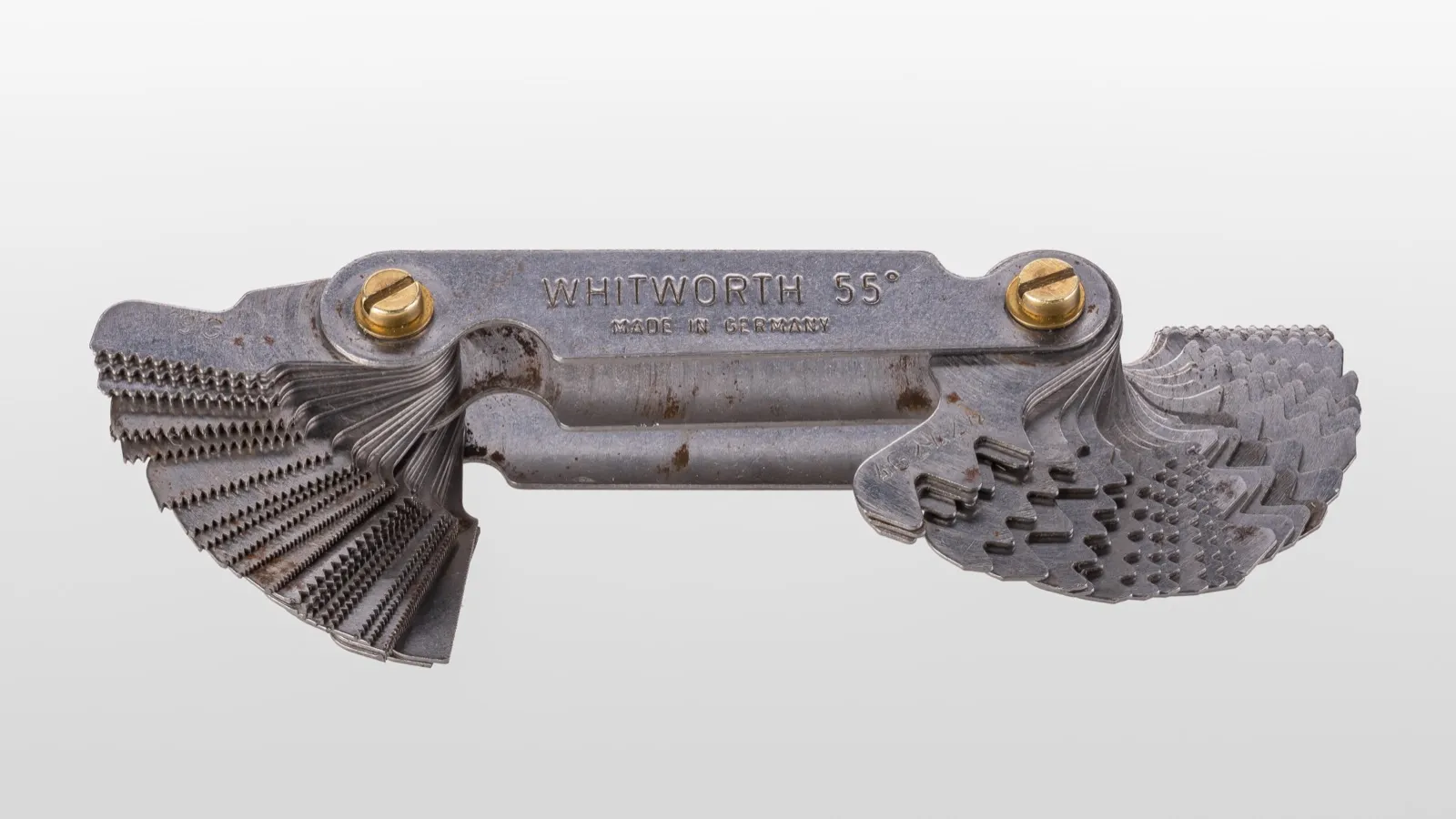
A pitch gauge is the usual tool for naming a thread. Hold the gauge leaves against the thread until one fits without gaps. Match the leaf label, then check the diameter with a caliper.
When to buy the right length instead
Answer these in order:
- Is it a standard thread you can name? If not, buy a pitch gauge first, not a screw.
- Is a stock length within 3 mm of what you need? Buy that one.
- Is the screw hardened, plated or a special head, such as a socket head? Buy the right length (hardness is a reason a hacksaw may skid, unverified).
- Is the screw a one of a kind part from your hilt maker? Ask the maker, since altering it may affect your warranty.
- Is it a plain machine screw or thumb screw? Cut it.
A spare screw costs less than a stripped hole. The lightsaber parts list lists the small items to keep as spares, and stuck screws and blade plugs covers removal. For hilt work beyond screws, see customize a lightsaber hilt, lightsaber hilts for how the parts fit together, and build your own lightsaber if the screw is part of a full build.
Sources
- Wikipedia, Unified Thread Standard, https://en.wikipedia.org/wiki/Unified_Thread_Standard (accessed 2026-11-07)
- Wikipedia, ISO metric screw thread, https://en.wikipedia.org/wiki/ISO_metric_screw_thread (accessed 2026-11-07)
- EngineerFix, How to cut a screw and restore the threads, https://engineerfix.com/how-to-cut-a-screw-and-restore-the-threads/ (accessed 2026-11-07)
- Model Engineer and Workshop forum, Shortening Screws, https://www.model-engineer.co.uk/?p=36663 (accessed 2026-11-07)
- AIMS Industrial, Hacksaw blade guide: TPI, materials and how to choose, https://aimsindustrial.com.au/blogs/product-guides/hacksaw-blade-guide-tpi-materials-and-how-to-choose-the-right-blade (accessed 2026-11-07)
- Aspen Fasteners, #8-32 x 1 thumb screws, knurled head with shoulder, brass, https://www.aspenfasteners.com/8-32-x-1-thumb-screws-knurled-head-with-shoulder-brass/ (accessed 2026-11-07)
- Lightsaber troubleshooting and repair, stuck screws and blade plugs, /lightsaber-troubleshooting-and-repair/ (maker guidance cited there, checked 2026-11-07)
- OSHA, Eye and face protection, https://www.osha.gov/eye-face-protection (accessed 2026-11-07)
- Wikipedia, Bolt cutter, https://en.wikipedia.org/wiki/Bolt_cutter (accessed 2026-11-07)
- Wikipedia, Brass, https://en.wikipedia.org/wiki/Brass (accessed 2026-11-07)
- Handbook, glossary (blade retention thumb screw), handbook/glossary.md (reviewed 2026-11-07)
FAQ
Can you cut a screw shorter?
Yes. Use a nut on the thread, a fine hacksaw or rotary tool, a file for the bevel, then unscrew the nut to clean the thread [3][4].
What is the best way to cut a screw shorter?
A hacksaw with the screw clamped and a nut on the thread is the most controlled way. A rotary tool is faster but heats the metal [3].
Will a cut screw still thread in?
Usually, if you deburr the end and run the nut off over it. If it binds, reshape the thread with a file or die [3].
Can I shorten a brass thumb screw?
Yes. Brass is soft and cuts easily, so go slowly and file lightly [10]. Check the listing for full thread length first [6].
What is an 8-32 thumb screw?
It is a #8 screw with 32 threads per inch and a head you turn by hand. The major diameter is 0.164 inch [1].
Can I use a metric screw instead?
Only if it matches the hole. Metric and inch sizes differ in pitch and diameter, so measure the hole thread first [1][2].
Editorial team
Writes for Saber Forge Forum. Every guide is checked against the maker's specs and dated, so you know how fresh it is.
Read next
Customize a Lightsaber Hilt: Take It Apart, Finish and Modify
To customize a lightsaber hilt, first take it apart: empty it, then free glued threads with heat or acetone, or a vice with soft jaws. Then choose a finish (weathering, etching, powder coat, wrap) and mods like kill keys, windows and accent LEDs. Check wall thickness before you drill.
Lightsaber Troubleshooting and Repair: Documented Fixes
Most lightsaber faults trace back to a low or badly seated battery, a bad or corrupt SD card, or a loose connector. This page collects the troubleshooting steps that board makers and vendors document for no power, no sound, flicker, charging, SD card and stuck screw problems, with a safety note on batteries and opening hilts.
Lightsaber Parts List: Everything You Need to Build One
A DIY lightsaber needs a hilt, chassis, sound board, blade, protected 18650 battery, speaker, switches, wire and a charge port. Verified prices as of November 2026: boards from $40.40, empty hilts from $51.25, a pixel blade bundle at $104.28. Battery and speaker prices are unverified.