Lightsaber Hilts: Types, Materials and Empty Hilts Explained
A lightsaber hilt is the handle and body of a saber, everything except the blade. Empty hilts come without electronics, a chassis holds the board and battery inside, and most real hilts are machined aluminium or printed plastic. Empty hilts start around $51 as of November 2026.
On this page11 sections
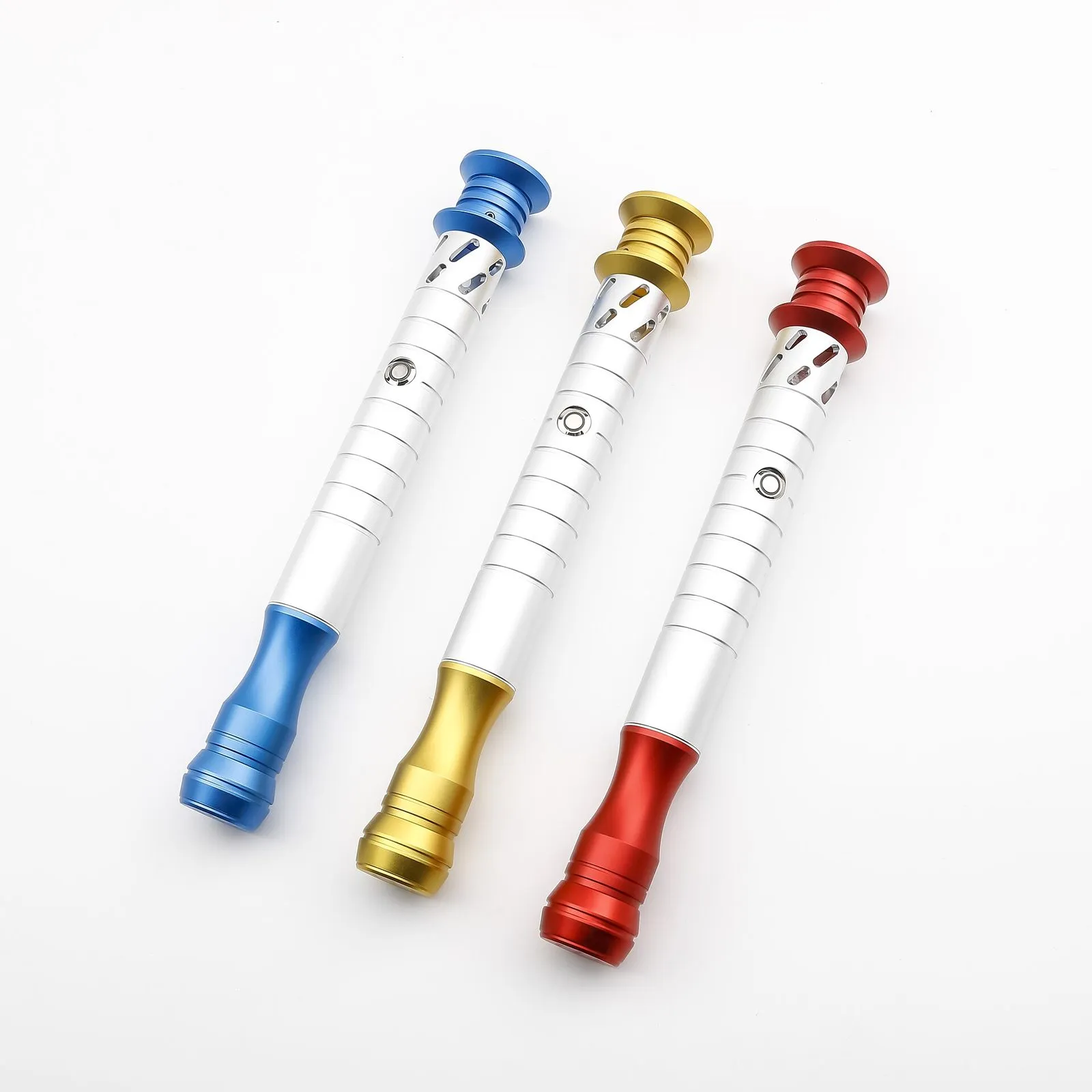
Lightsaber hilts are the handle and body of a lightsaber: everything you hold, without the blade. A hilt can be sold empty, as a shell for you to fill, or installed, with board, speaker and battery already inside [1]. Empty lightsaber hilts start at $51.25 at one vendor, as of November 2026 [2].
This page explains the parts, materials and types. To build one, follow build your own lightsaber. For the full shopping checklist see the lightsaber parts list.
What a lightsaber hilt is
The handbook defines the hilt as the whole body without the blade [1][3]. Inside it sits the electronics. Outside, the visible shape is what makes one saber look different from another.
The word covers a lot of ground. A prop-style grip, a modern machined body and a printed fan design are all hilts. What they share is a blade opening at the top and room for the internal parts.
Parts of a hilt
| Part | What it does |
|---|---|
| Emitter | Top section that holds the blade [1] |
| Shroud | Cover over the emitter, often removable [1] |
| Body | Middle section where the chassis runs [1] |
| Chassis | Inner frame for board, speaker and battery [1] |
| Pommel | Bottom cap that keeps the contents in [1] |
| Blade plug and retention screw | Plug closes the emitter, the screw locks the blade [1] |
| Switch, charge port, kill key | Control, charging and a removable circuit break [1] |
Empty hilts versus installed sabers
An empty hilt is a body with no working electronics. One shop describes its empty hilts as built to take its blades, with electronics, batteries and sound sold as separate categories [2]. A second shop labels its F16 hilt “an empty hilt kit” that is “not a working hilt” [4].
An installed saber has the board, speaker and battery fitted. One shop lists installed sabers at about $400 to $665, as of November 2026, against empty hilts typically $100 to $350 at the same shop [5]. The gap is the parts and work you add yourself.
Choose empty if you want to pick the board, blade and sound yourself. Choose installed if you want to start playing. For ready-made options see the best lightsaber guide.
What a chassis does
The chassis is the frame that holds the board, speaker and battery so nothing rattles inside the body [1]. Some chassis are 3D printed. A designer’s printed chassis for a Proffieboard build exists on marketplace listings, and shops sell standard chassis as a category [4][6]. One maker’s listing describes a plastic standard chassis with a metal version planned (search result snippet, not confirmed on the page) [7].
A chassis is cut for a specific hilt. Parts from different modular systems do not interchange [1][3].
Hilt materials
Lore pages talk about exotic metals. Real hilts are simpler.
- Machined aluminium. The F16 hilt from The Custom Saber Shop is machined from 6061 aluminium, as of November 2026 [4]. Other makers advertise aluminium bodies too (search result snippets, unverified) [7].
- Brass and copper accents. A custom maker lists copper, brass and aluminium parts on one design (search snippet, unverified) [7].
- Printed plastic. Used for chassis and some hilts. Plastic conducts heat worse than metal, so powerful LEDs in a printed body need an aluminium tube inside [3].
Machined metal
- Pro: handles heat and knocks better [3]
- Con: higher price, for example $131.25 for the F16 (list price $175.00) [4]
3D printed
- Pro: cheap to make and easy to customise [3]
- Con: worse heat control, so the build needs care [3]
Types of lightsaber hilts and saber types
The saber type decides how many blades the hilt holds and how much room you get.
| Type | Hilt note | Where to read more |
|---|---|---|
| Single blade | One emitter; the common starting point | This page |
| Double-bladed (staff) | Two emitters, or two hilts joined by a coupler [2] | Double-bladed lightsaber |
| Crossguard | Side emitters need more LEDs and current [1] | Crossguard lightsaber |
| Prop-style grip | Display-oriented bodies, such as grip kits (one shop lists a $65.00 kit, as of November 2026) [8] | This page |
Blade technology also shapes the hilt. A thin neck lets more light into a baselit blade but holds up worse in a duel [1]. Pixel blades give even brightness along the length but are more fragile than baselit tubes [1].
How to choose a hilt
- Pick the blade first. The hilt must take its diameter. Many hilts use a 1 inch blade [3]. The F16 page gives a 1 inch inner diameter [4].
- Check threads. The F16 uses MHS V2 threads, so parts from other systems may not fit [4].
- Check the electronics space. The F16 includes a switch box for two 12 mm switches and a hole for a recharge port [4].
- Decide the use. Display, costume or contact play each ask for a different body and blade. Dueling hilts and heavy blades are covered in the dueling hub.
What hilts cost
All prices are from vendor pages read in November 2026.
- Ultrasabers empty hilts: $51.25 to $66.25 for the first 12 of 16 models [2].
- The Custom Saber Shop F16: $131.25 [4].
- Saberbay empty hilts: typically $100 to $350 [5].
- Graflex-style grip kit: $65.00 at one shop [8].
Prices change, and delivery to your country is not guaranteed [3].
Common hilt problems
Most hilt trouble comes from small parts rather than the body.
- Stripped retention screw. The side screw that locks the blade is overtightened or its thread wears, a frequent complaint in the handbook sources [1][3].
- Stuck blade plug. The plug that closes the emitter can seize in its thread [1].
- Wrong system. Buying a chassis or module that belongs to another system. The handbook notes an older modular system and a newer one were not compatible [1].
- Heat in a plastic body. Printed bodies trap heat from powerful LEDs unless metal sits inside [3].
Handle every thread gently, use the correct hex key, and test-fit before final assembly. The full order of work is in build your own lightsaber.
FAQ
What is the hilt of a lightsaber?
The body you hold: emitter, body and pommel, without the blade [1][3].
What is an empty lightsaber hilt?
A hilt with no working electronics. You add the board, speaker, battery and blade [2][4].
What does a lightsaber chassis do?
It is the inner frame that holds the board, speaker and battery [1].
What are lightsaber hilts made of?
Machined aluminium is common, with brass or copper accents on some designs. Printed plastic is used for chassis and some bodies [4][3].
Are hilts from different makers interchangeable?
Usually not. Threads and chassis are cut per system [1][4].
Sources
- Handbook, What are lightsabers, handbook/what-are-sabers.md (reviewed 2026-11-01)
- Ultrasabers, Empty sabers, https://ultrasabers.com/product-category/empty-sabers/ (accessed 2026-11-06)
- Handbook, DIY sabers, handbook/sabers/diy.md (reviewed 2026-11-01)
- The Custom Saber Shop, F16 Hilt Gold/Black, https://www.thecustomsabershop.com/Product/Index/1822 (accessed 2026-11-06)
- Saberbay, shop front page, https://www.saberbay.com/ (accessed 2026-11-06)
- Printables, Chassis for Savi’s/Galaxy’s Edge Lightsaber, https://www.printables.com/model/273203-chassis-for-savisgalaxys-edge-lightsaber (accessed 2026-11-06)
- Shtok Customworx, Revanted hilt (search result snippet), https://shtokcustomworx.com/products/revanted-hilt (accessed 2026-11-06)
- The Custom Saber Shop, shop front page, https://www.thecustomsabershop.com/ (accessed 2026-11-06)
Editorial team
Writes for Saber Forge Forum. Every guide is checked against the maker's specs and dated, so you know how fresh it is.
Read next
Build Your Own Lightsaber: A Step-by-Step DIY Guide
To build your own lightsaber, pick a route (assembled kit, plug-in modules, or a soldered Proffieboard build), buy a matching hilt and parts, bench-test the wiring, then install the software and close the hilt. A first soldered build is a weekend or two. Read the battery and soldering safety rules first.
Lightsaber Parts List: Everything You Need to Build One
A DIY lightsaber needs a hilt, chassis, sound board, blade, protected 18650 battery, speaker, switches, wire and a charge port. Verified prices as of November 2026: boards from $40.40, empty hilts from $51.25, a pixel blade bundle at $104.28. Battery and speaker prices are unverified.