Laser Lightsaber: Why a 7W Laser Is Not a Toy
A laser lightsaber is a high power handheld laser in a hilt shaped housing. It makes a thin beam, never a blade, and a multi-watt beam such as the 7W builds people post is a Class 4 laser that can blind in an instant and start fires. Pointers are capped at 5 mW in the US and far lower in the UK and Australia, so buy a prop saber or a flashlight instead.
Short answer
A laser lightsaber is a high power handheld laser in a hilt shaped housing. It makes a thin beam, never a blade, and a multi-watt beam such as the 7W builds people post is a Class 4 laser that can blind in an instant and start fires. Pointers are capped at 5 mW in the US and far lower in the UK and Australia, so buy a prop saber or a flashlight instead.
On this page9 sections
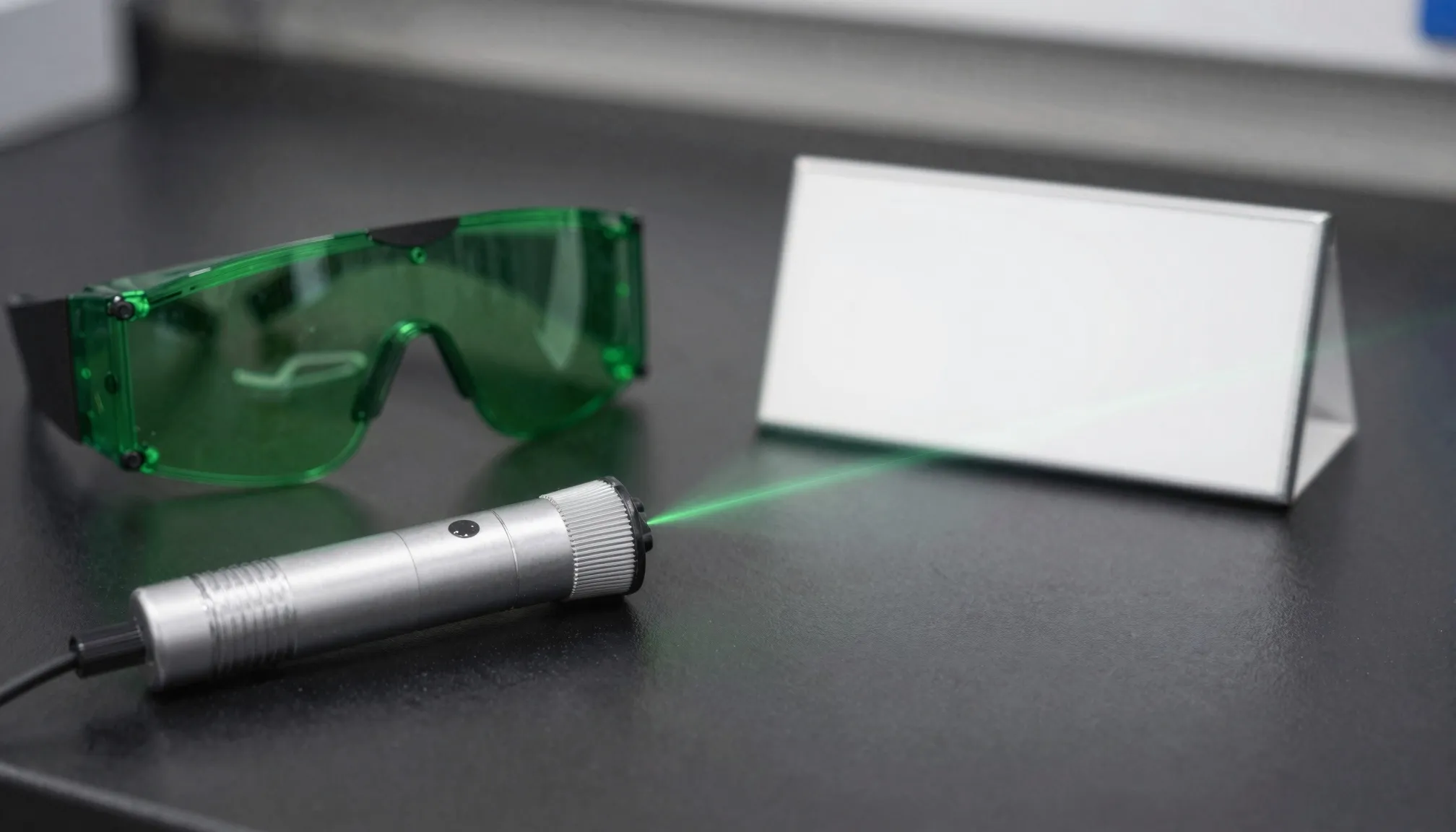
A “laser lightsaber” is a handheld laser built into a housing that looks like a saber hilt. It does not make a blade. It makes a thin beam that keeps going until it hits something, and the multi-watt versions people search for, such as a “7W laser”, fall in Class 4, the most dangerous laser class. A beam like that can burn the retina before you can blink and can set things on fire [1][2]. The US caps laser pointers at 5 mW, the UK steers consumers to Class 2 or below, and Australia bans importing pointers above 1 mW without a permit [3][1][5].
This page explains the risk. It does not cover how these devices are built or where they are sold, and it never will. If you want something that looks like a lightsaber, the best lightsaber guide and the toy lightsaber page cover safe ones.
Why a laser cannot be a lightsaber
A film lightsaber stops at a fixed length and meets resistance when it hits another blade. A laser does neither. The light travels in a straight line until something absorbs or reflects it, so the “blade” would reach across the room and out of the window. In clean air you only see the beam where dust or smoke scatters it.
That is why every real saber you can buy is a lamp in a tube. A polycarbonate blade glows because LEDs light it from inside or from the hilt. Our explainer on how lightsabers work goes through the parts, and the real lightsaber page covers lasers, plasma and the lab experiments in more depth.
What people mean by “7W laser” and “laser lightsaber”
The phrase covers two things. Some are cheap pointers sold in a hilt shaped shell. Others are hobby builds posted online that put a high power laser module in a saber style tube and advertise output in watts.
Watts is the number to watch. A milliwatt (mW) is a thousandth of a watt, so a 7 W claim is 7,000 mW. That is 1,400 times the 5 mW US limit for pointers and far above the 500 mW line where Class 4 starts [3][1]. Labels on these products are often wrong in both directions. The UK government warns that a laser marked Class 2 or “under 1 mW” can turn out to be Class 3B or Class 4 when measured [1].
Laser classes from Class 1 to Class 4
The international standard for laser product safety is IEC 60825-1, published in the UK as BS EN 60825-1 [6][1]. It sorts lasers into classes by how much harm the accessible beam can do. The table summarises the main classes using the UK government’s plain language guide [1].
| Class | Typical power (visible light) | Eye risk | Skin and fire risk |
|---|---|---|---|
| 1 | Very low | Safe in normal use, though a bright beam can dazzle [1] | None |
| 2 | Below 1 mW | Safe for a brief glance because you blink and turn away, hazardous if you stare [1] | None |
| 3R | Up to 5 mW | Low but not zero, and rises with exposure time [1] | None in normal use |
| 3B | Up to 500 mW | A direct beam into the eye is normally hazardous [1] | Minor skin injury at the top end, can ignite flammable material when focused [1] |
| 4 | Over 500 mW | Direct beam is hazardous and can cause permanent sight loss [1] | Skin burns and often a fire hazard [1] |
The US uses older names in its rules (Class IIIa for up to 5 mW, Class IIIb for 5 to 500 mW), but the lines are the same [3].
Eye, skin and fire hazards
The eye focuses visible light onto a tiny spot on the retina. That is what makes lasers dangerous at powers that feel harmless on your hand. The blink reflex is what protects you from a Class 2 pointer. At higher power the damage happens faster than you can blink or turn away [1].
UK eye specialists who answered a 2017 government call for evidence warned of permanent damage from retinal burns caused by misuse of laser pointers [2].
Class 4 adds two more problems. The beam can burn skin, and it can light paper, fabric and other flammable material [1]. A saber shaped housing makes this worse, because the device invites the very thing you must never do with it: waving it around near people.
There is a fourth risk that affects everyone else. The FAA says that pointing a laser at an aircraft is a federal crime in the US [7]. A beam that dazzles a pilot can endanger a whole plane.
What the law says about pointers
Rules differ by country, and they change. These are the main ones we could confirm on official pages today.
- United States: FDA limits laser pointers to 5 mW of visible light. It says Class IIIb lasers cannot legally be promoted as pointers or demonstration products, and calls them too dangerous for use as pointers or amusement articles [3].
- United Kingdom: Government guidance says consumer laser products should be Class 1, Class 2 or a limited subgroup of Class 3R, that products likely to appeal to children must not exceed Class 1, and that Class 3B and Class 4 lasers are not for general consumer use [1]. The Office for Product Safety and Standards ran a “Laser pointers are not toys” campaign in 2018 [2].
- Australia: Hand-held laser pointers with an output above 1 mW have been prohibited imports since 1 July 2008 unless you hold a permit from the Australian government [5][4]. States add their own rules. In New South Wales you need a police permit to own and use a pointer over 1 mW, and you must show a genuine reason [8].
Other countries have their own limits. If you are unsure, assume a multi-watt handheld laser is illegal to import, carry or use where you live.
Why it is not a toy
A Class 4 laser is industrial and lab equipment. Labs that use one have trained staff, protective eyewear rated for the exact wavelength, controlled rooms and written safety rules. A hilt shaped housing has none of that. It also looks like a toy, which is exactly why regulators single out laser products that appeal to children [1].
Do not buy one as a gift, and do not let a child near one. If you already have a device like this, stop using it and ask your local council or waste service how to dispose of it safely.
Safe alternatives
You can get the look without the hazard.
- A prop lightsaber. Baselit and neopixel sabers glow along the whole blade and react to swings with sound. Start with the best lightsaber guide, or the brightest lightsaber page if you want the most light.
- A saber for a child. The best lightsaber for kids guide covers age labels and lighter blades.
- A flashlight shaped like a saber. The lightsaber gadgets page covers torches and lamps in hilt shapes, which give you a beam of ordinary light.
None of these will cut anything. Nothing sold to the public will, and that is the point.
Sources
- GOV.UK, Laser radiation: safety advice, https://www.gov.uk/government/publications/laser-radiation-safety-advice/laser-radiation-safety-advice (accessed 2026-11-18)
- GOV.UK (Office for Product Safety and Standards), Laser pointers are not toys (3 December 2018), https://www.gov.uk/government/news/laser-pointers-are-not-toys (accessed 2026-11-18)
- US Food and Drug Administration, Important information for laser pointer manufacturers, https://www.fda.gov/radiation-emitting-products/laser-products-and-instruments/important-information-laser-pointer-manufacturers (accessed 2026-11-18)
- Australian Border Force, Specified person test (permits for restricted imports including laser pointers), https://www.abf.gov.au/prohibited-goods-subsite/Pages/specified-person-test.aspx (accessed 2026-11-18)
- Federal Register of Legislation (Australia), Customs (Prohibited Imports) Amendment Regulations 2008 (No. 3), item 48, https://www.legislation.gov.au/F2008L01400/asmade (accessed 2026-11-18)
- IEC, IEC 60825-1:2014 Safety of laser products, Part 1: Equipment classification and requirements, https://webstore.iec.ch/en/publication/3587 (accessed 2026-11-18)
- Federal Aviation Administration, Lasers, https://www.faa.gov/go/lasers (accessed 2026-11-18)
- Australian Business Licence and Information Service (NSW Police Force), Prohibited weapons: laser pointer permit, https://ablis.business.gov.au/service/new-south-wales/prohibited-weapons-laser-pointer-permit/38066 (accessed 2026-11-18)
FAQ
Is a laser lightsaber real?
Not as a blade. It is a handheld laser in a hilt shaped shell. The beam has no fixed length and does not stop at a blade tip.
How dangerous is a 7W laser?
Very. 7 W is 7,000 mW, far into Class 4, which UK guidance describes as hazardous to the eye and skin and often a fire hazard [1].
Are laser pointers over 5 mW legal?
In the US, FDA limits pointers to 5 mW and says Class IIIb lasers cannot legally be promoted as pointers [3]. Australia restricts imports above 1 mW, and New South Wales requires a permit to own one [5][8].
Can a laser pointer blind you?
Yes. Eye specialists have warned of permanent retinal burns from misuse [2]. The higher the power, the less time it takes.
What is a safe alternative to a laser sword?
A prop lightsaber with an LED blade, or a saber shaped flashlight. Both give you light without a focused beam.
What should I do if a laser hits my eye?
See an eye doctor promptly, even if you feel no pain, and report the incident if someone aimed it at you.
Editorial team
Writes for Saber Atlas. Every guide is checked against the maker's specs and dated, so you know how fresh it is.
Read next
Real Lightsaber: Is One Possible and What You Can Buy
A real lightsaber that works like the films, with a solid blade of fixed length that cuts, does not exist. Light passes through light, lasers do not stop, and plasma needs fuel or an arc. What exists are plasma proto-builds and hobby sabers with a lit blade that does not cut.
How Do Lightsabers Work? In Star Wars and in Real Life
In Star Wars canon a lightsaber is a plasma blade made by a power cell and a kyber crystal in the hilt, held in shape by a containment field. A real hobby saber works differently: a battery, a control board, a speaker and a motion sensor drive LEDs inside or behind a polycarbonate tube. Nothing real cuts.
Lightsaber Gadgets: Chopsticks, Lighters, Pens and Lamps
Lightsaber gadgets are everyday items styled like a saber hilt: light-up chopsticks, torch and plasma lighters, flashlights, pens and lamps. This guide shows what each type is, what to check before buying, and the safety and legal points for lighters, lasers and small batteries.
Best Lightsaber for Kids: Safe Picks by Age and Budget
The best lightsaber for kids depends on age. Under about 8, choose a plastic or foam toy lightsaber with a printed age label. From about 8 to 12, a small, light baselit saber with an adult nearby. Metal duelling sabers are sold for teens and adults. Read the age label first.
Toy Lightsaber Guide: Types, Prices and What to Check
A toy lightsaber comes in five common types: foam or inflatable, light-up plastic, extendable, sound-and-light electronic, and licensed Hasbro or Disney models. Check the age label, the battery door and the materials, and expect a toy to differ a lot from a hobby saber. For age and safety advice, use the kids guide.
Best Lightsaber to Buy in 2026: Picks by Use and Budget
There is no single best lightsaber, so this list picks one per use: Xenopixel for a first serious saber, baselit for duelling and kids, a licensed Hasbro replica for the shelf, Proffieboard for DIY. Specs, price bands and warranty terms from vendor pages.
Brightest Lightsaber: What Makes a Blade Bright
No vendor page checked for this guide publishes a measured brightness for a whole lightsaber. Brightness comes from LED colour and drive current, pixel count along the blade, the tube, the light around you and the battery. Pixel blades usually look brighter than baselit, but they draw more power and run hotter.