Real Lightsaber: Is One Possible and What You Can Buy
A real lightsaber that works like the films, with a solid blade of fixed length that cuts, does not exist. Light passes through light, lasers do not stop, and plasma needs fuel or an arc. What exists are plasma proto-builds and hobby sabers with a lit blade that does not cut.
Short answer
A real lightsaber that works like the films, with a solid blade of fixed length that cuts, does not exist. Light passes through light, lasers do not stop, and plasma needs fuel or an arc. What exists are plasma proto-builds and hobby sabers with a lit blade that does not cut.
On this page11 sections
A real lightsaber, meaning a blade of fixed length that stops in mid air and cuts what it touches, does not exist. Light does not stop at a length, lasers are not blades, and plasma needs fuel or an electric arc. What you can build or buy is a hobby saber with a lit blade that does not cut, and a few plasma flame builds that are not safe toys [1][2][8].
Real lightsaber at a glance
| Approach | Does it exist | What stops it from being a lightsaber |
|---|---|---|
| Laser blade | Lasers exist, blades do not | A beam has no fixed end and no push [2][10] |
| Plasma blade | Gas plasma torches and flame builds exist | Needs fuel or an arc, power supply and gas tanks [7][8][9][12] |
| Photon molecules | A lab result, 2013 | Needs near absolute zero atoms, proof of concept only [5] |
| Hobby saber | Yes, you can buy one | The blade is lit, it does not cut [1][11] |
To skip to the buying advice, go to what you can buy. The rest explains why.
Why light does not stop at a length
In the fiction, the blade is energy that a crystal channels and an emitter shapes, with a power cell in the hilt [2]. The first problem is stopping. A beam of light travels until something absorbs or reflects it. It has no reason to end after a metre.
The second problem is the clash. Physicist Dennis Killinger is quoted as saying that two light beams pass through each other without pushing, because photons have no mass [2]. Under ordinary conditions photons pass through one another, so light does not cast shadows or collide [6]. Two light “blades” would cross like two torch beams.
Lab exceptions exist, covered below, but none gives you a handheld blade.
Lasers
A laser is the obvious first idea, and it fails both tests. The beam does not end at a set length, and it does not meet resistance when it hits something else. You also see a beam only where dust or smoke scatters it, so a “blade” in clear air would be hard to see (editorial explanation).
Lasers are also a real hazard. The FDA limits handheld laser pointers to 5 milliwatts of visible light. Above that, the eye’s blink reflex does not protect you, and severe retinal damage can happen after a moment of exposure [10]. Labels are unreliable: an FDA official estimated that about 60 percent of sampled pointers were stronger than labelled. The same source says not to buy laser pointers for children [10].
A laser sold as a lightsaber is a laser pointer in a hilt. Skip it.
Plasma
Plasma is a hot ionized gas, and experts keep returning to it. A proposed design is a plasma blade shaped by an electromagnetic coil, though the power technology for it does not exist yet [2]. One seller explainer calls a plasma beam possible in theory, and names power and containment as the obstacles, but cites no physics papers [3].
Plasma cutting is real industry. A cutter forces compressed gas through a nozzle, and an electric arc ionizes it into a jet that melts metal. It needs a power source and a gas supply. Handheld torches exist and cut steel plate up to about 38 mm (1.5 in) [12]. That is a tool with a cord and a hose, not a blade that stops.
A fuel-based plasma flame is the other route. A writer for a tech site sketched a blade from a laminar jet of fuel and oxidiser, and noted that the best-known heat-resistant material melts near the temperature of a propane flame [4]. The sketch is a thought experiment, not a built device.
Photon molecules
This is the research people mean when they say “real lightsabers are coming”. In September 2013 a Harvard and MIT team led by Mikhail Lukin and Vladan Vuletic published a paper in Nature, “Attractive photons in a quantum nonlinear medium” [5]. They cooled a cloud of rubidium atoms to a few degrees above absolute zero and sent in very weak laser pulses carrying single photons. Because of an effect called the Rydberg blockade, two photons influenced each other and left the cloud together as a bound pair [5].
Lukin said the push and deflection between photons resembles what the films show [5]. He also called the work a proof of concept, aimed at quantum switches and logic gates, not weapons [5].
A 2024 result from the University of Ottawa shows the same limit from another side. A green laser in a ruby crystal cast a shadow with up to 22 percent contrast, but the effect comes from the crystal’s matter, not light alone [6]. Light interacting with light needs special matter. A hilt cannot carry a cloud at near absolute zero.
The closest builds
Hacksmith Industries holds a Guinness World Record for the first retractable proto-lightsaber, dated October 2020 on the record page, though the page text gives September [7]. Guinness says the saber links to propane and oxygen tanks, and the beam reaches about 2,204 degrees Celsius (4,000 degrees Fahrenheit) [8]. Wikipedia describes it as a gas-fuelled plasma lightsaber that can cut metal [9]. The maker’s stated purpose is to build working prototypes of fictional gadgets to inspire interest in science [8].
The word “proto” matters here. It is tethered to gas tanks and burns fuel. It reads as a demonstration build, not a product (editorial view). The same maker moved to a facility with clean rooms for handling liquid oxygen in 2022, aiming at a self-contained version [9].
What you can buy
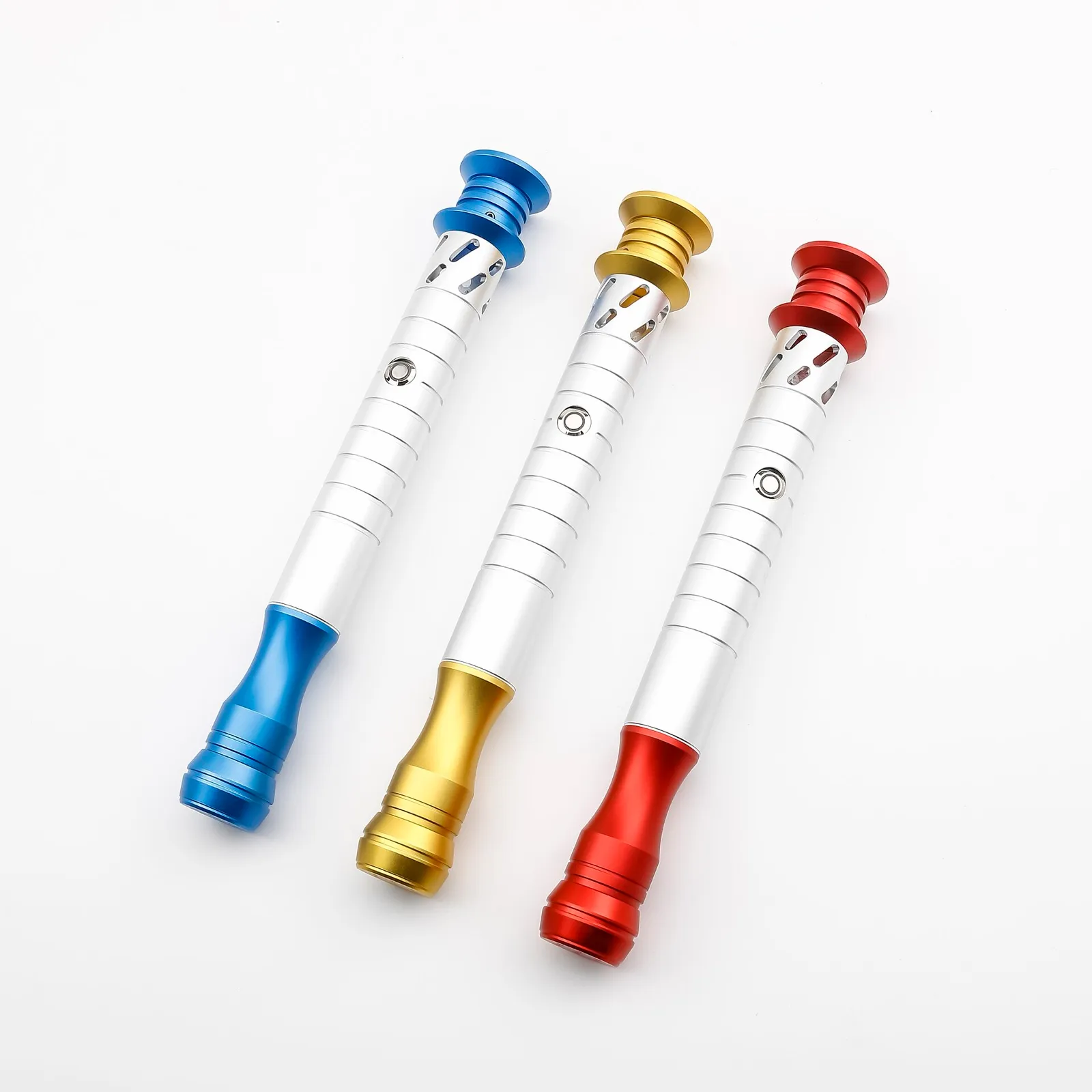
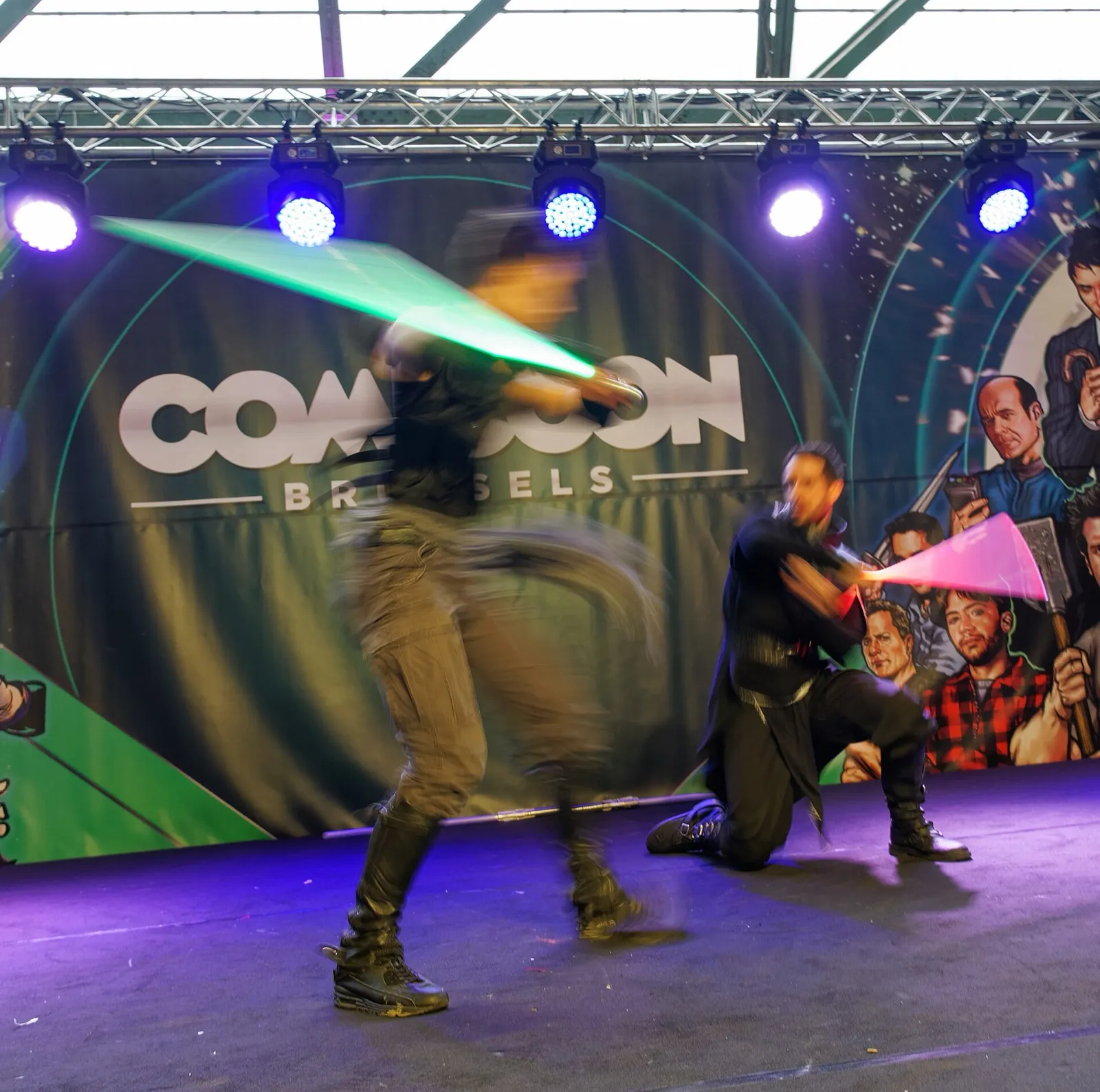
You can buy a lightsaber replica whose blade lights up. In a Neopixel saber the blade is polycarbonate with LEDs inside it, more than a hundred individually addressable ones along the length, and the light is even from base to tip [11]. The maker calls the polycarbonate blade sturdy enough for most dueling [11]. The full explanation is in Neopixel lightsaber, and the board choice is covered in Xenopixel vs Neopixel.
These sabers have sound, motion effects and a rechargeable cell. They do not cut. One custom neopixel hilt listed at $170 on a maker’s page as of November 2026, built to order with a lead time of up to four weeks, though the page showed it sold out when read [13].
| What you want | What exists | Where to look |
|---|---|---|
| A lit blade for display or cosplay | Hobby saber, LED blade | Best lightsaber |
| A saber for light contact | Dueling-grade polycarbonate blade | Best lightsaber for dueling |
| A safe saber for a child | Lower-power hobby saber | Best lightsaber for kids |
| A film-style replica | Licensed or fan replica | Conversions and replicas |
| A blade that retracts | Fan builds only | Types of lightsabers |
Be suspicious of anything advertised as a “real” lightsaber that “cuts” or “burns”. Sellers use “real” to mean “a metal hilt with a lit blade”, which is the hobby saber above [11].
Which real lightsaber to pick
- If you want to cut things, you want a tool, not a saber. A plasma cutter is a workshop machine with a gas supply and shade 8 eye protection [12].
- If you want to watch physics, read the 2013 paper or the Ottawa result in the sources [5][6].
- If you want to hold a saber, choose a hobby saber. Start with best lightsaber.
- If you want to duel, choose a baselit or pixel saber rated for it, and read how to duel with a lightsaber.
- If it is for a child, read best lightsaber for kids first.
Is a real one possible
Not with current technology, and the sources describe no path to one. A solid beam that cannot pass through another needs interaction that light does not offer. A plasma blade needs a containment and power system that does not exist at handheld scale [2][4]. A fuel flame is a torch [8].
The nearest thing is a different object: a hobby saber you can hold, hear and duel with [1][11]. The lightsaber first appeared in the 1977 film Star Wars [1]. For which saber appears in which film, see every lightsaber by film, and for the design types, with canon and Legends examples marked, see types of lightsabers.
Last checked: 2026-11-07.
Sources
- Lightsaber, Wikipedia, https://en.wikipedia.org/wiki/Lightsaber (accessed 2026-11-07)
- Is It Possible To Create A Real Star Wars Lightsaber?, Looper, https://www.looper.com/1458283/star-wars-lightsabers-possible-to-create/ (accessed 2026-11-07)
- Is a Real Lightsaber Possible?, Nsabers (seller blog), https://nsabers.com/blogs/lightsabers-guide/is-a-real-lightsaber-possible (accessed 2026-11-07)
- We’re closer than ever before to creating a real lightsaber, The Next Web, https://thenextweb.com/news/how-to-make-a-lightsaber-star-wars-day (accessed 2026-11-07)
- Seeing light in a new way, Harvard-MIT release, via ScienceDaily (25 September 2013), https://www.sciencedaily.com/releases/2013/09/130925132323.htm (accessed 2026-11-07)
- Laser beam casts a shadow in a ruby crystal, Physics World (16 December 2024), https://physicsworld.com/a/laser-beam-casts-a-shadow-in-a-ruby-crystal/ (accessed 2026-11-07)
- First retractable proto-lightsaber, Guinness World Records, https://www.guinnessworldrecords.com/world-records/635154-first-retractable-plasma-lightsaber (accessed 2026-11-07)
- Canadian Inventor Hacksmith creates world’s first retractable lightsaber, Guinness World Records (December 2020), https://www.guinnessworldrecords.com/news/2020/12/canadian-inventor-hacksmith-creates-world%E2%80%99s-first-retractable-lightsaber-641762 (accessed 2026-11-07)
- The Hacksmith, Wikipedia, https://en.wikipedia.org/wiki/The_Hacksmith (accessed 2026-11-07)
- Laser pointer eye injury, American Academy of Ophthalmology, https://www.aao.org/eye-health/news/laser-pointer-eye-injury (accessed 2026-11-07)
- What Is a Neopixel Lightsaber?, Ultrasabers (1 May 2023), https://ultrasabers.com/holocron/what-is-a-neopixel-lightsaber/ (accessed 2026-11-07)
- Plasma cutting, Wikipedia, https://en.wikipedia.org/wiki/Plasma_cutting (accessed 2026-11-07)
- Neo Reaver Brushed Silver Black, Sabertrio listing, https://sabertrio.com/products/reaver-neo-cfx-saber-brushed (accessed 2026-11-07)
FAQ
Can a real lightsaber exist?
Not with current technology. A beam of light does not stop at a fixed length, two beams pass through each other, and plasma needs fuel or an arc [2][9][12].
Is the Hacksmith saber a real lightsaber?
It is a plasma proto-lightsaber that Guinness records as a first retractable one. It runs from propane and oxygen tanks [7][8]. It is a stunt build, not a consumer product.
Can a laser be a lightsaber?
No. A laser has no fixed end, and above 5 milliwatts it is an eye hazard [10].
Can you buy a real lightsaber?
You can buy a hobby saber with a lit blade. It does not cut [11]. Prices vary: see best lightsaber.
What did the Harvard and MIT photon research show?
Photons bound into pairs inside a super cold atom cloud. It is a proof of concept for quantum devices, not a blade [5].
Is a real lightsaber legal to own?
This page did not find a source on legality. Check local rules for lasers and open flames (unverified).
Editorial team
Writes for Saber Forge Forum. Every guide is checked against the maker's specs and dated, so you know how fresh it is.
Read next
Neopixel Lightsaber: What It Is and Which One to Buy
A neopixel lightsaber has an LED strip inside the blade, so the glow is even from hilt to tip and the blade can animate. Entry models start around $180, mid-range around $320 to $400, Proffie sabers from about $400. Duelling needs a tougher blade.
Best Lightsaber to Buy in 2026: Picks by Use and Budget
There is no single best lightsaber, so this list picks one per use: Xenopixel for a first serious saber, baselit for duelling and kids, a licensed Hasbro replica for the shelf, Proffieboard for DIY. Specs, price bands and warranty terms from vendor pages.