Brightest Lightsaber: What Makes a Blade Bright
No vendor page checked for this guide publishes a measured brightness for a whole lightsaber. Brightness comes from LED colour and drive current, pixel count along the blade, the tube, the light around you and the battery. Pixel blades usually look brighter than baselit, but they draw more power and run hotter.
Short answer
No vendor page checked for this guide publishes a measured brightness for a whole lightsaber. Brightness comes from LED colour and drive current, pixel count along the blade, the tube, the light around you and the battery. Pixel blades usually look brighter than baselit, but they draw more power and run hotter.
On this page11 sections
The brightest lightsaber is, in practice, a pixel blade with many LEDs per inch, a clear polycarbonate tube and enough battery to feed it. Nobody publishes a measured brightness for a whole saber, so “brightest” is a claim you compare, not a figure you look up. The sections below show what drives brightness, which numbers vendors do give, and how to compare two sabers fairly [8][9][11].
Last checked: 2026-11-07.
What makes a blade bright
Six things set how bright a blade looks:
- LED colour. The same watts give different light in different colours [1][5].
- Drive current and the LED part. More current means more light, up to the heat limit [2][15].
- How many LEDs light the blade, and where they sit [7][9][13].
- The tube and any diffuser around the LEDs [13][14].
- The light around you. A blade is judged against its surroundings [3][4].
- The battery and the board that limits current [15][8].
Old forum advice from the 2010s listed colour, wattage, blade length, hilt neck and charge. That list mostly still holds. The brand comparisons from that era are out of date, so none are repeated here.
LED colour and lumens
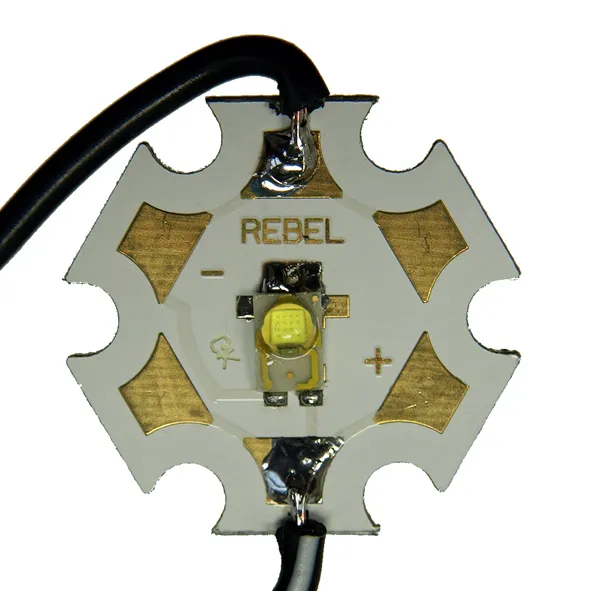
Lumens count light the eye sees. They are not watts. A datasheet gives lumens for one LED at a stated current, and the figure differs a lot by colour.
| LUXEON Rebel colour | Typical output at 350 mA [1] |
|---|---|
| Lime | 184 lm |
| Green | 79 to 102 lm |
| Blue | 22 to 41 lm |
| Royal blue | 520 mW radiant (not lumens) |
Lime gives roughly 4 to 8 times the lumens of blue at the same current (our arithmetic from [1]). Lumileds notes a flux tolerance of 6.5 percent [1]. Royal blue is binned in milliwatts because lumens would undersell it [1].
White parts use the same units. Cree lists a minimum of 180 lm at 350 mA and 85 °C for one 7000 K XLamp XP-G3 bin [2]. That is a different LED family from the Rebel, so the two tables are not a like for like ranking. For a full colour comparison, see LED wattage and brightness. For the Cree parts used in baselit builds, see tri Cree vs quad LED.
Watts and pixel count
A watt figure tells you power draw, not light [5]. Luminous efficacy is lumens per watt, and it changes with colour and part [5].
On a pixel blade, brightness rises with the number of LEDs lit and the current each gets. Adafruit says each NeoPixel draws up to 60 mA at full white, and recommends 20 mA per pixel as a rule of thumb for mixed colours [6]. One 144 per metre strip is listed at 35 W maximum [7]. A 36 inch blade is about 0.91 m, so the same density gives roughly 130 pixels and up to about 32 W at full white (our arithmetic from [7]). Real blades run well below that.
A hobbyist’s own build used 233 LEDs at 22.3 W. He reports it at 3.4 times the output of an earlier saber, in arbitrary photometer units on his own page [13]. It is one builder’s measurement, not a standard.
More pixels mean more light and more current. They also mean more heat and a shorter runtime [6][8][12].
Blade tube and diffusion
A pixel blade has its LEDs inside a polycarbonate tube [11][14]. A baselit blade is a hollow tube lit from the hilt [8][11]. Both depend on the tube to spread light.
The one builder who tested diffusers reports that every diffuser he tried made a radially facing LED design worse [13]. That is a single hobbyist’s result for one layout. Most vendors say nothing about the tube or diffuser they use. Ask the seller:
- Is the tube clear, frosted or lined with a diffuser?
- How many LED rows are inside?
- Does the blade have a tip cap or mirror?
Baselit and pixel brightness profile
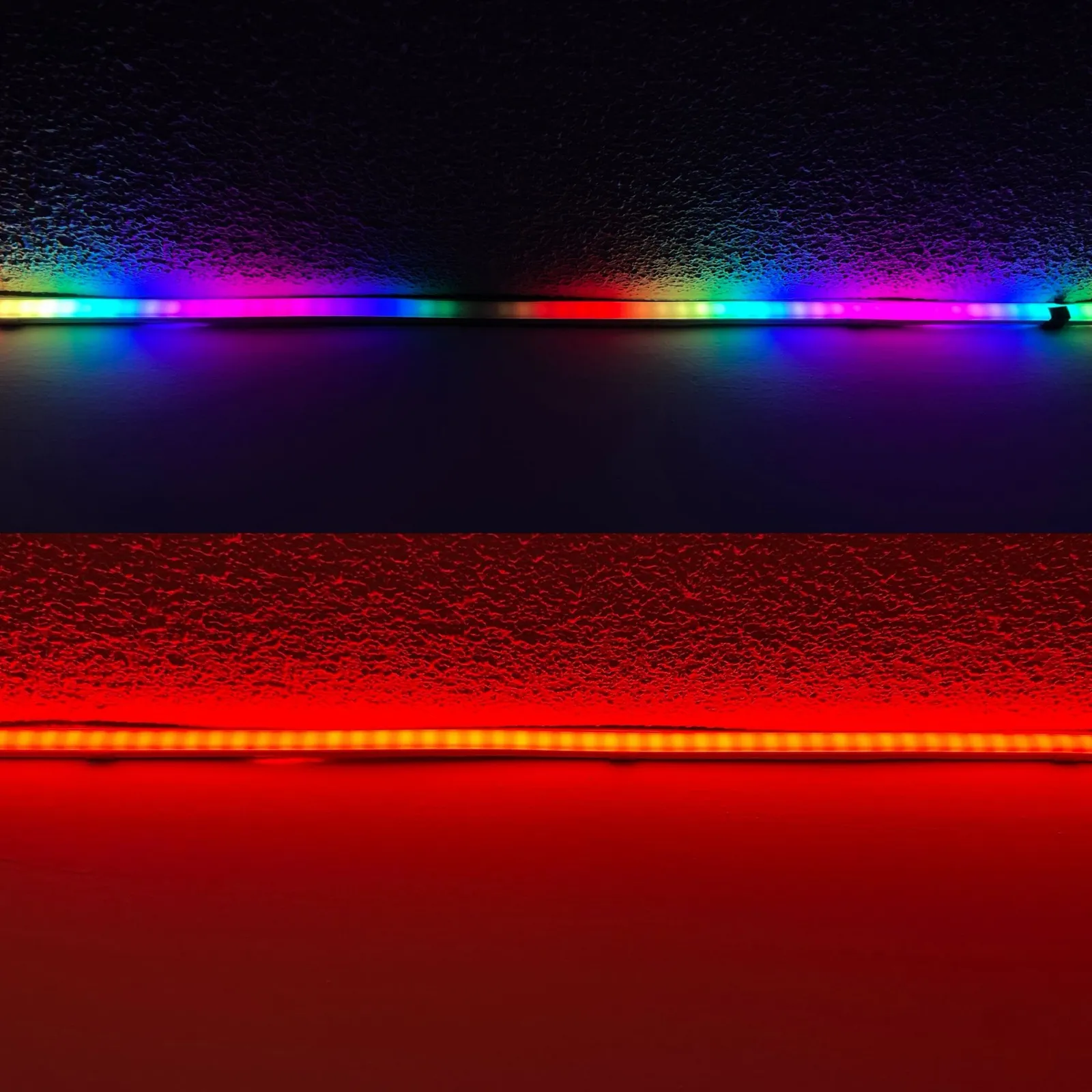
Baselit light is strongest at the hilt and fades toward the tip [8][12]. A longer blade fades more. A pixel blade is lit along its whole length, so brightness is even [11][12].
The Saber Factory rates its baselit blade Medium and its neopixel blades High [8]. Ultrasabers and NovaSaber describe the same split [11][12]. Neither gives a measured figure. See baselit vs neopixel for the full trade-off, and neopixel lightsaber for pixel sabers on their own.
Brightness numbers vendors publish
Vendors publish power, LED counts and sometimes lumens for a part. They rarely publish lumens for a complete saber. Searches for a named saber’s lumens, the “destiny one lumens” type, run into the same gap. No vendor page opened for this guide gave a whole-saber figure.
| What is stated | Example | Value |
|---|---|---|
| Watts of the LED | The Saber Factory baselit blade [8] | 12W RGB |
| Watts of the strip | The Saber Factory neopixel blades [8] | 50W neopixel strip |
| LED count | Korbanth Super Pixel Blade, 34 inch [9] | 684 LEDs, against 148 in standard pixel blades |
| Brightness comparison | Same listing [9] | 35 percent brighter, no method stated |
| Lumens of a part (vendor) | Tri-Rebel star at 700 mA [10] | Red 90, green 161, blue 58, white 235 lm |
| Lumens of a part (maker datasheet) | LUXEON Rebel lime at 350 mA [1] | 184 lm typical |
| Whole saber lumens | None found | Not stated |
Prices seen on these pages as of November 2026: the Korbanth blade is $109.00 [9] and the tri-Rebel star is $16.00 [10].
Read the Korbanth numbers with care. 684 against 148 is about 4.6 times as many LEDs (our arithmetic), the same listing’s copy says nearly three times, and the brightness gain is given as 35 percent with no method [9]. Wattage on a listing is also not light. A 50W strip and a 12W LED tell you the power budget, not the lumens [5][8].
Daylight visibility
Daylight is far brighter than a room. Wikipedia lists typical illuminance at 320 to 500 lux in an office, 1,000 on a cloudy day, 10,000 to 25,000 in full daylight without direct sun and 32,000 to 100,000 in direct sunlight [3]. A clear daytime sky has a luminance of about 3,000 to 10,000 cd/m2, while a typical LCD monitor peaks near 250 cd/m2 [4].
A blade has to stand out against that background. NovaSaber says its pixel blade is “extremely bright, making them visible even in daylight”, and says subtle effects are easier to see in dim light [11]. That is a vendor claim with no lux or luminance figure.
What helps in daylight, as our reading of the figures above:
- Choose a bright colour. Lime and green give more lumens than blue at the same current [1].
- Choose a pixel blade over baselit for an even glow along the whole blade [8][11].
- Expect shade or a cloudy sky to help more than a stronger LED in direct sun [3][4].
Battery and heat
A brighter blade draws more. Ultrasabers says neopixel sabers drain batteries significantly faster than standard ones [12]. The Saber Factory lists a 3000 mAh 18650 for its baselit saber at 1 to 3 hours, and a 3600 mAh 18650 for a neopixel saber at 30 to 90 minutes [8]. Those are vendor runtime ranges, not measurements. See lightsaber batteries for cell choice and care.
Heat is the other limit. A builder’s first full power strip melted its tube. The final version runs at 40 percent of maximum, with a short burst mode for combat [14]. Datasheets show the same pattern in the LED itself. The XP-G3 sheet gives a maximum junction temperature of 150 °C, and Lumileds publishes a curve of light output against junction temperature [1][2].
ProffieOS handles this in software. If the battery voltage is above what the LED is rated for, it lowers brightness to protect the LED [15]. A saber that dims on its own after a minute may be doing exactly that, or may be limited by heat. The troubleshooting guide covers the colour shift side.
How to compare two sabers
Compare in this order:
- Fix the colour. Compare white with white, or lime with lime [1].
- Ask for the LED part and drive current, or the pixel count and strip density [6][7][9].
- Ask for datasheet lumens at a stated current, not watts alone [1][5].
- Check the blade style. Pixel for even brightness, baselit for toughness and runtime [8].
- Compare the runtime at the brightness you will actually use [8].
- Look for a thermal limit or brightness cap, and ask how it behaves in a closed tube [14][15].
- Treat daylight visibility and 35 percent brighter claims as marketing until a method is given [9][11].
If you can measure, put a lux meter at the same distance from each blade and record base, middle and tip. That one test would answer most of what no vendor publishes.
Sources
- Lumileds, LUXEON Rebel Color Line datasheet DS68, https://www.luxeonstar.com/wp-content/uploads/documentation/ds68.pdf (accessed 2026-11-07)
- Cree LED, XLamp XP-G3 product family data sheet, https://downloads.cree-led.com/files/ds/x/XLamp-XPG3.pdf (accessed 2026-11-07)
- Wikipedia, Lux, https://en.wikipedia.org/wiki/Lux (accessed 2026-11-07)
- Wikipedia, Orders of magnitude (luminance), https://en.wikipedia.org/wiki/Orders_of_magnitude_(luminance) (accessed 2026-11-07)
- Wikipedia, Luminous efficacy, https://en.wikipedia.org/wiki/Luminous_efficacy (accessed 2026-11-07)
- Adafruit, Powering NeoPixels (NeoPixel Uberguide), https://learn.adafruit.com/adafruit-neopixel-uberguide/powering-neopixels (accessed 2026-11-07)
- Adafruit, NeoPixel Digital RGB LED Strip 144 LED 1m, product 1506, https://www.adafruit.com/product/1506 (accessed 2026-11-07)
- The Saber Factory, Baselit or Neopixel Lightsaber, https://www.thesaberfactory.com/blogs/lightsaber-knowledge/baselit-or-neopixel-lightsaber (accessed 2026-11-07)
- Korbanth, Super Pixel Blade 1 inch diameter 34 inch length, https://korbanth.com/super-pixel-blade-1-inch-diameter-34-inch-length/ (accessed 2026-11-07)
- The Custom Saber Shop, Luxeon Tri-Rebel Star, https://www.thecustomsabershop.com/Electronics/LEDs/Luxeon-Tri-Rebel/Luxeon-Tri-Rebel-Star (accessed 2026-11-07)
- NovaSaber, Neopixel Lightsaber Technology Explained, https://novasaber.com/pages/neopixel-lightsaber-technology-explained-novasaber-official-guide (accessed 2026-11-07)
- Ultrasabers, What Is a Neopixel Lightsaber, https://ultrasabers.com/holocron/what-is-a-neopixel-lightsaber/ (accessed 2026-11-07)
- Wayne’s This and That, lightsaber blade LED research page, https://www.waynesthisandthat.com/lightsaber.html (accessed 2026-11-07)
- Hackaday, Building the brightest light sabre in the world, https://hackaday.com/2016/10/25/building-the-brightest-light-sabre-in-the-world (accessed 2026-11-07)
- ProffieOS documentation, LED configuration, https://pod.hubbe.net/config/blades/led-configuration.html (accessed 2026-11-07)
- City of Melbourne (FL) Fire Prevention Office, Lithium-ion Battery Safety Tips, adapted from NFPA, https://www.melbourneflorida.org/Government/Departments/Fire-Department/Fire-Prevention-Office/Fire-Prevention-Safety-Tips/Lithium-ion-Battery-Safety-Tips (accessed 2026-11-07)
FAQ
What is the brightest lightsaber?
No whole saber has a published lumen figure in the pages checked. Pixel blades with many LEDs usually look brightest [8][9][11].
What makes a lightsaber blade brighter?
LED colour, drive current, pixel count, tube and diffusion, and battery. Heat limits all of them [1][6][14][15].
Is a 12W LED brighter than a 6W LED?
Not by wattage alone. Light depends on colour and part as well as power [1][5]. See the colour guide.
Is a neopixel blade brighter than baselit?
Vendors rate it so: The Saber Factory lists High for neopixel and Medium for baselit [8]. It is also more even along the blade [11][12].
How many lumens is a lightsaber?
Vendors give lumens for single LEDs, such as a tri-Rebel star at 700 mA [10], not for a whole saber. Treat any whole saber lumen claim as unverified.
Will a bright lightsaber show in daylight?
Daylight is about 10,000 lux or more outside direct sun [3]. Vendors claim visibility but give no figure [11]. Shade and overcast help most.
Editorial team
Writes for Saber Forge Forum. Every guide is checked against the maker's specs and dated, so you know how fresh it is.
Read next
Baselit vs Neopixel Lightsaber: Light, Durability and Cost
A baselit lightsaber, also called in-hilt, puts one LED in the hilt and sends light up a hollow tube. A neopixel blade carries an LED strip inside. Baselit is cheaper, lighter and the safer pick for hard dueling. Neopixel is brighter along the whole blade and does the film-style ignition.
Tri Cree vs Quad LED for a Lightsaber
A tri Cree LED puts three separate LED dies on one heat-sinking star, and a quad puts four. Both light a baselit saber from the hilt. Quad gives more mixing options and more light for the same lens, and also needs more current, cooling and care. Pixel blades have replaced both for most new builds.
How to Choose a Lightsaber Blade Color: LED and Pixel Guide
Pick a blade color by wavelength and brightness, not by name. Lime and green LEDs give the most light, blue and deep red give the least, and cameras exaggerate blue. Pixel blades set color in software. In-hilt LEDs fix it in the emitter. Watts claimed on a listing say little.
Neopixel Lightsaber: What It Is and Which One to Buy
A neopixel lightsaber has an LED strip inside the blade, so the glow is even from hilt to tip and the blade can animate. Entry models start around $180, mid-range around $320 to $400, Proffie sabers from about $400. Duelling needs a tougher blade.