How to Parry With a Lightsaber: Real Sword Technique
To parry with a lightsaber, meet the incoming blade with the strong part of your own, using a small, controlled movement, then follow with a riposte. The method comes from fencing, kendo and HEMA, and you can practice it with real polycarbonate blades, slowly and in protective gear.
Short answer
To parry with a lightsaber, meet the incoming blade with the strong part of your own, using a small, controlled movement, then follow with a riposte. The method comes from fencing, kendo and HEMA, and you can practice it with real polycarbonate blades, slowly and in protective gear.
On this page11 sections
To parry with a lightsaber, meet the incoming blade with the strong part of your own, using a small movement that is just wide enough for the attack to miss, then answer with a counterattack called a riposte [1][2]. The method comes from sword arts, not from the films, and clubs teach it slowly, with a partner and protective gear [4][7][8].
This page goes deeper on one skill. For the whole path from first saber to first club, read how to duel with a lightsaber.
Can you parry in real life
Yes. Fencers, kendo practitioners and HEMA students parry in real life every week. Fencing defines a parry as a bladework maneuver that deflects or blocks an incoming attack [1]. Lightsaber sport uses the same idea with polycarbonate blades, and Theory Sabers says students first learn controlled parrying with small, efficient movements that save energy [7].
The film behavior is where it stops carrying over. In the films a lightsaber blade is deflected by another blade with a crackle [12], but the choreography itself drew on kendo and fencing [12]. A real polycarbonate blade is a physical tube, so contact between two blades is ordinary blade contact. This guide covers physical practice, not video game parry timing, which works on its own mechanics. For what counts as a real lightsaber, see real lightsaber.
What a parry is
A parry is a simple defensive action that deflects the attack with the blade’s forte, usually just wide enough for the attacking blade to miss [2]. The forte is the bottom third of a fencing blade, near the guard, and it gives strong leverage. The foible is the top third, with less leverage, and is used for beats and fast actions [2].
In fencing, the parrying fencer’s forte meets the opponent’s foible, which pushes the attack away and leaves the defender in a good position to counterattack [1]. A parry is usually followed by a riposte, an attack made immediately after a successful parry [1][2]. Theory Sabers uses the same terms for lightsaber dueling [7].
Parry positions
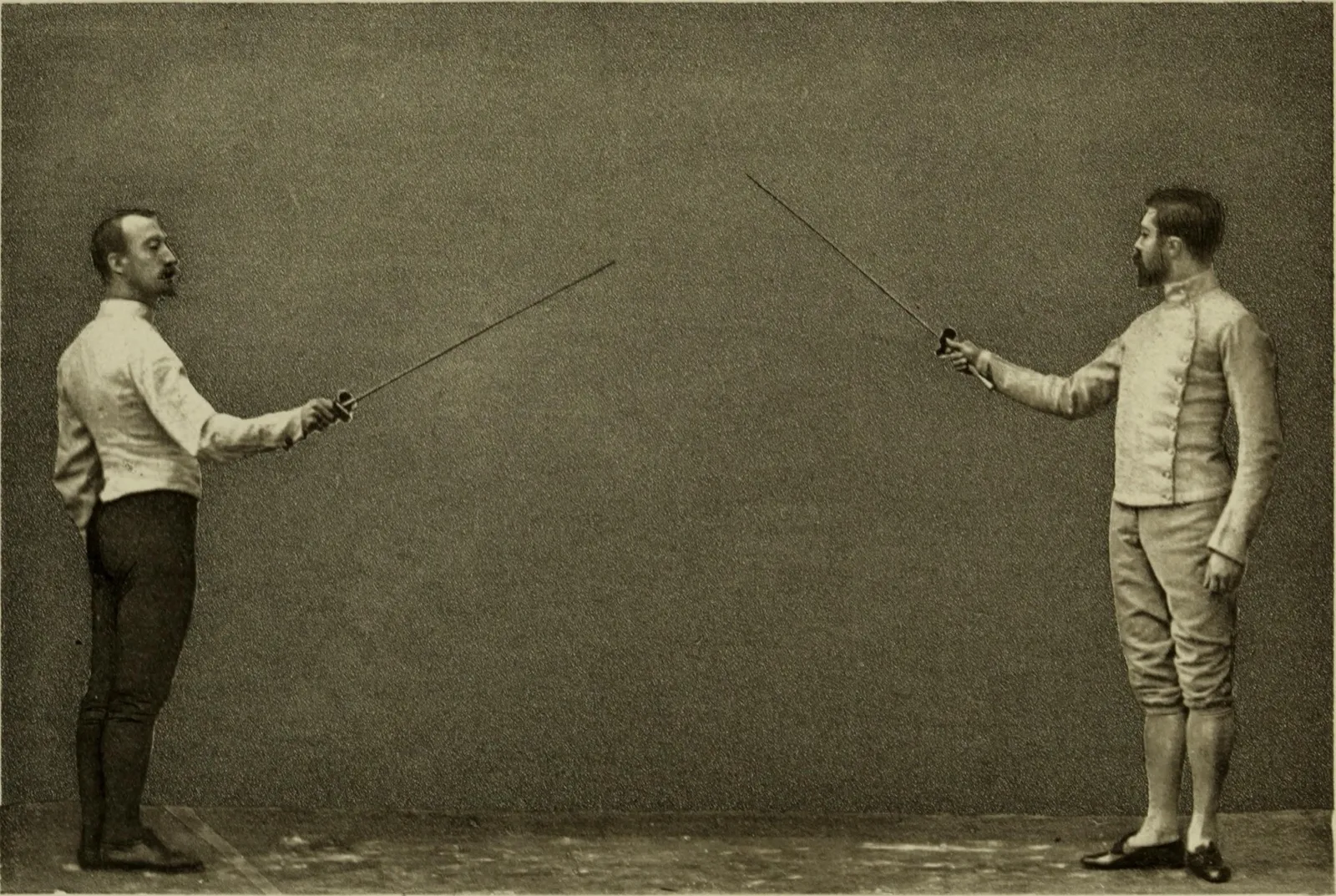
Classical fencing numbers eight parries by direction (up or down), side (inside or outside) and wrist rotation [1]. Sabre fencing uses a different set, and a few positions vary by school [1][2]. The table below shows the foil and épée set as the glossary defines it.
| Parry | Number | Blade | Wrist | Covers |
|---|---|---|---|---|
| Prime | 1 | Down, inside | Pronated | Inside low line [2] |
| Seconde | 2 | Down, outside | Pronated | Outside low line [2] |
| Tierce | 3 | Up, outside | Pronated | Outside high line [2] |
| Quarte | 4 | Up, inside | Supinated | Inside high line [2] |
| Quinte | 5 | Up, inside, point above hand | Pronated | Head in sabre [2] |
| Sixte | 6 | Up, outside | Supinated | Outside high line [2] |
| Septime | 7 | Down, inside | Supinated | Inside low line [2] |
| Octave | 8 | Down, outside | Supinated | Outside low line [2] |
A parry usually covers one “line” of the body [2]. The names are fencing terms. The seven lightsaber forms in the films are fiction, though they are a fun way to think about defense, as the lightsaber forms guide explains.
Parry types from sword arts
Each art has its own parries. The sources name these.
- Simple parry: a straight-line movement that deflects the attack [2].
- Circle parry (counter-parry): a circular movement that ends where it began and usually traps an attack in the same high or low line from a different direction [2].
- Beat parry: a sharp, controlled blow to the opponent’s blade that deflects it and creates an opening for a riposte [2].
- Opposition parry: a parry that sends the attack into the opposite line using leverage [2].
- Kendo counters: suriage sweeps the opponent’s shinai upward in a rising slide and then strikes, while kaeshi parries, turns the hands over, and strikes the opposite side [4]. The motion must be smooth, not two separate movements [4].
- HEMA absetzen: deflecting a thrust or hew while stabbing in the same action [6].
Fencers also use the prise de fer, a blade engagement that tries to control the opponent’s weapon, or move it, before hitting [1][2].
Blade-on-blade basics
Where blades touch is called the bind. In the German longsword tradition, strong and weak refer to the force applied in the bind: strength is countered with weakness, and weakness with strength [6]. The fencer senses the opponent’s pressure (“fühlen”) to decide whether to be weak or strong [6].
On timing, the same tradition speaks of acting in the “indes”, the time the opponent needs to complete an action [6]. In practice that means a parry that also threatens, not a pure block. Theory Sabers says defense is meant to pair with offense, and a riposte keeps pressure on the opponent [7].
Fencing adds a rule layer. In foil and sabre, a successful parry transfers priority (right of way) to the defender, whose riposte then takes priority [1][3]. Épée has no priority, so any deflection that stops the attack counts [1]. This is sport scoring, not a lightsaber rule, but it explains why fencers treat the parry-riposte as one unit.
How to parry step by step
This list is put together from the sources above. It is not a coaching program.
- Set your gear and the rules. Mask, gloves, agreed target zones and a stop signal [8].
- Start with footwork. Theory Sabers says training usually starts with footwork and basic defensive moves before harder strikes [7].
- Pick one line. Practice a single parry, such as tierce, covering one line of the body [2].
- Meet with the forte. Take the attack on the strong part of the blade, near the hilt [2].
- Keep the movement small. Deflect just wide enough for the attack to miss [2][7].
- Add the riposte. Counter immediately after the parry [2].
- Reset. Recover distance, and stop if control is lost [8].
Drills
Build intensity gradually. The Saber Factory says to throw a move hard only once it can be repeated slowly with clean form [8]. Kendo practitioners likewise practice each technique slowly with a partner first, then increase speed as confidence grows [4].
- Slow, cooperative parry and riposte. One partner feeds a slow attack to one line, the other parries and counters, then switch. Rehearse as you would choreography [8].
- Footwork before blades. Circling the opponent and adjusting distance can force mistakes and open attack windows [7].
- Non-dominant hand. Theory Sabers recommends it, especially for dual wielding [7].
- Pace-up drills. Move to light, controlled sparring only when both are comfortable [7][8].
- Studying video of bouts or choreography. Theory Sabers lists this as a way to refine timing and rhythm [7].
Common mistakes
- Chasing power. The Saber Factory says power magnifies mistakes and control reduces them [8].
- Overcommitting. Reckless swings leave a fighter exposed, and forcing an attack usually works worse than waiting for an opening [7].
- Big, wide blocks. The parry is meant to be just wide enough [2]. Small, efficient movements save energy [7].
- Using the weak part. The forte is the part to parry with [2].
- Mixing choreography and sparring. Planned moves and reactive sparring have different rules [8].
- Skipping the gear check. Fatigue, loose gear and frustration are all reasons to stop [8].
- Using a display saber. A thin or pixel blade may not survive repeated contact. See best lightsaber for dueling.
Where to practice
Clubs teach parries under supervision. LudoSport says technique is the first form of safety, and its only mandatory protection is gloves, with masks recommended [9][10]. Lightspeed Saber League requires a fencing mask and lacrosse gloves for sparring [11]. Ask any club for its written rules before you go. HEMA and fencing clubs also teach parry fundamentals, and HEMA gear often resembles sport fencing equipment [5].
Sources
- Wikipedia, Parry (fencing), https://en.wikipedia.org/wiki/Parry_(fencing) (accessed 2026-11-07)
- Wikipedia, Glossary of fencing, https://en.wikipedia.org/wiki/Glossary_of_fencing (accessed 2026-11-07)
- Wikipedia, Fencing, https://en.wikipedia.org/wiki/Fencing (accessed 2026-11-07)
- Wikipedia, Kendo, https://en.wikipedia.org/wiki/Kendo (accessed 2026-11-07)
- Wikipedia, Historical European martial arts, https://en.wikipedia.org/wiki/Historical_European_martial_arts (accessed 2026-11-07)
- Wikipedia, German school of swordsmanship, https://en.wikipedia.org/wiki/German_school_of_swordsmanship (accessed 2026-11-07)
- Theory Sabers, Lightsaber Dueling Breakdown, https://www.theorysabers.com/article/lightsaber-dueling-breakdown (accessed 2026-11-07)
- The Saber Factory, 10 Lightsaber Dueling Safety Tips That Actually Matter, https://www.thesaberfactory.com/blogs/lightsaber-knowledge/lightsaber-dueling-safety-tips (accessed 2026-11-07)
- LudoSport, Saber and protective gear page, https://ludosport.net/more-saber.html (accessed 2026-11-07)
- Wikipedia, Ludosport, https://en.wikipedia.org/wiki/Ludosport (accessed 2026-11-07)
- Lightspeed Saber League, Safety rules, https://cang-snow.squarespace.com/safetyrules (accessed 2026-11-07)
- Wikipedia, Lightsaber, https://en.wikipedia.org/wiki/Lightsaber (accessed 2026-11-07)
FAQ
How do you parry with a lightsaber?
Meet the attack with the strong part of the blade, deflect it with a small movement, and counterattack right away [1][2][7]. Practice slowly, with a mask and gloves.
Can you parry in real life with a lightsaber?
Yes, with polycarbonate sport blades. The mechanics come from fencing, kendo and HEMA [1][4][5][7].
Is blocking the same as parrying?
Not quite. A block stops the blade. A parry deflects it, usually with the forte, and sets up a riposte [1][2].
Which part of the blade should I parry with?
The forte, the strong part near the hilt, not the foible near the tip [2].
Can I parry with a double-bladed or dual-wield saber?
Theory Sabers says dual wielders assign roles to each blade, one defending and the other exploiting openings [7]. A double-bladed saber needs extra room and slower practice [8]. See double-bladed lightsabers.
Can kids learn to parry?
Lightspeed lists extra pads for under-16 fencers [11], and The Saber Factory says children need active supervision, not just someone nearby [8]. See best lightsaber for kids for blade choices.
Do I need a club?
Clubs bring supervision, written rules and approved gear [9][11]. Learning alone leaves no one to spot unsafe habits.
Last checked: 2026-11-07. For blade size and diameter, see lightsaber blade length.
Editorial team
Writes for Saber Forge Forum. Every guide is checked against the maker's specs and dated, so you know how fresh it is.
Read next
How to Duel With a Lightsaber: Parry, Spar and Stay Safe
To duel with a lightsaber safely, use a saber with a thick polycarbonate blade, wear a fencing mask and padded gloves, agree rules and target zones before igniting, learn footwork and small parries first, and train with a club. Real leagues differ on gear, so check their rules.
Lightsaber Forms I to VII: What Each Form Is and Who Used It
Star Wars names seven lightsaber forms. Form I Shii-Cho is the basic one, II Makashi is for saber duels, III Soresu is defense, IV Ataru is acrobatic attack, V Shien and Djem So counter, VI Niman balances, VII Juyo and Vaapad is the fiercest. Each entry lists its known users.
Best Lightsaber for Dueling: Blade, Models and Protective Gear
For hard contact, pick a baselit saber with a thick-walled polycarbonate blade, 2 mm at least and 3 mm for heavy sparring. Pixel blades suit light contact and choreography. Below: vendor-listed duel-ready models with prices as of November 2026, what to check, and the gear to buy.
Lightsaber Blade Length: 32 vs 36 Inch and How to Choose
Most vendors treat 36 inches as the standard adult blade and 32 inches as the pick for shorter or younger users and for tight spaces. Choose by height, space and use, then check the hilt's blade diameter and socket depth, because the usable length is shorter than the listing.